Showing posts with label Bull shark. Show all posts

Tuesday, September 18, 2012

Incident Mar. 20, 2012 - Australia - Billy O'Leary


View Shark Attacks 2012 in a larger map

March 20, 2012
Billy O'Leary
Nobbys Beach, Gold Coast, Australia

Billy O'Leary, 20, was surfing at Nobbys beach on the Gold Coast with his best friend Tyson Kolkka. O'Leary attempted a trick known as a "floater" but when he fell he landed on a large shark. The shark turned and bit O'Leary on the back of his left leg. Noel Kolkka, Tyson's father saw a comotion down on the beach and came to see what had happened:

"I just ran down the beach and I saw Billy lying on the sand. The lifeguards had got to him fairly quickly and were binding up all of his wounds and stopping the blood flow."

O'Leary sustained two significant lacerations to his leg. See a picture of his injury here.

Warren Young, chief lifeguard, said the suspect shark was probably a bull shark, lured in by baitfish and murky water.

Nobbys Beach
Source

Source:
www.news.com.au

Bull shark steals fish - video

This is such a great bull shark video.

Monday, September 17, 2012

Bull Shark (Carcharhinus leucas)

Source

Bull Shark Carcharhinus leucas

The bull shark, also known as the Zambezi shark in Africa, gets it's name from it's stocky build, it's broad snout, it's aggressive nature, and a tendency to head-butt it's prey before attacking. Bull sharks are arguably the most dangerous shark of all. They are among the top 3 most dangerous sharks in the world, alongside the tiger shark and the great white. Because the bull shark is very common, and lives in coastal shallow waters, often murky waters, they are considered responsible for most of the shark attacks that take place near the shore, even when the actual type of shark is not clearly identified. Due to it's agressive nature this shark has been nicknamed "The Pit Bull of the Sea."

Description

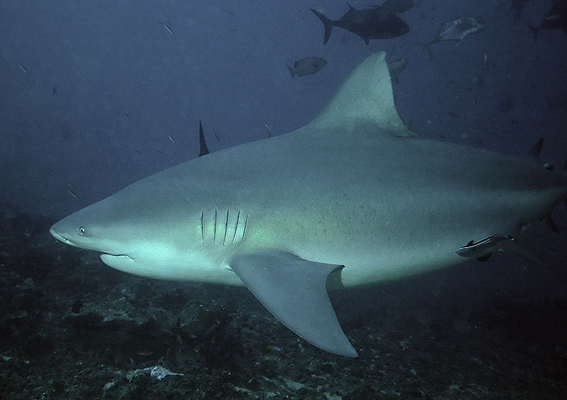
The bull shark's body is compact with a snout that is short and broad which gives it a somewhat blunt appearance. Bull sharks are short, wide and heavy fish, with a very powerful bite. The bull shark is grey with a white belly. They are a chunky species and the dorsal fin is relatively far forward on the shark's back. They have small beady eyes, making scientists believe that their eyesight is poor, hence their ability to thrive in the murky water that is commonly found in rivermouths and rivers. An adult bull shark's teeth are triangular, serrated, very sharp, and approximately 1.5" long.

Source

Bull sharks grow at about 11 inches a year for their first four years, and then at about six inches a year until fully mature. Females tend to be larger than males, mostly due to their longer lives; females live to be about 16 years old and reach maturity at about 10 years old and seven feet long, males live to about 12 years old, and reach maturity at 9 years and six feet long. The largest bull shark on record was 13 feet long and weighed close to 1000 pounds.

Range and Habitat

Bull sharks are commonly found worldwide in warm, shallow waters along coasts and in rivers, they prefer warmer equatorial, tropical and subtropical waters. Bull sharks are one of the very few sharks that have the ability to live in both salt and freshwater. They can be found in fresh water that connects with salt water (rivers and lakes) and have been caught in the Mississippi River as far upstream as Illinois.

Off the Atlantic coast of the United States, bull sharks are found from Massachusetts to the Gulf of Mexico and are common off southeastern Florida and in the Gulf of Mexico. Off the Pacific coast, bull sharks are found from southern California (rare) to the Gulf of California.

Here is an interactive map depicting the worldwide range of the bull shark.

Diet

Bull sharks are typically solitary hunters, they are very territorial and can be highly aggressive. They are known to make sharp turns, unpredictable bursts of speed (up to 11 mph) and often utilizes the "bump and bite" technique to capture prey, during which it first head-butts prey before attacking. Bull sharks are not picky eaters, they are opportunists and will eat almost anything they see: bony fish, turtles, birds, mollusks, crustaceans, dolphins, other sharks, and rays. They have also been known to eat birds, sloths, dogs, rats, cows and antelope! Like other sharks, they're able to find their prey with their keen sense of smell.

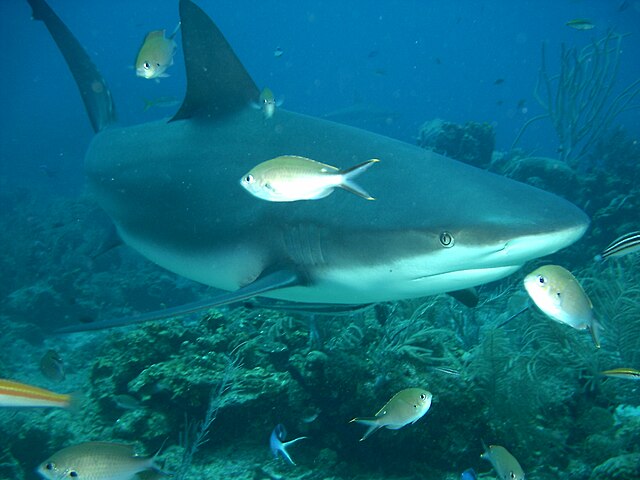
A bull shark cruising the shallow waters of the Carribean.
Source

Human-Shark Encounters

"Bull sharks inhabit quite shallow waters, which means that they do have a great opportunity to interact with humans, because the two species tend to share the same areas," said George Burgess, curator of the International Shark Attack File at the Florida Museum of Natural History in Gainesville.

According to the International Shark Attack Files, there have been 104 recorded bull shark attacks in the last 150 years, and out of those, 33 fatalities. While this number is probably under-reported due to the wide habitat of the bull shark which includes many third-world countries which do not report attacks, it is still an incredibly low number when you consider the number of people that enter the ocean every year.

Humans are a far greater threat to the shark population than they are to us. We fish them for sport as well as commercially, and their fins are also prized in Asian markets to turn into shark's fin soup.

Incident Mar. 15, 2012 - Florida - Frank A. Wacha Jr.


View Shark Attacks 2012 in a larger map

March 15, 2012
Frank A. Wacha Jr.
Jensen Public Beach, Florida

61 year-old Frank A. Wacha Jr. has been surfing for the past 50 years. Thursday was the first time he had ever been bitten by a shark. Wacha was surfing in choppy, murky water 120-150 yards off of Jensen Public beach when he felt something attach itself to his left arm.

"It felt just like I had been hit," said Wacha "My arm was out of the water," he said. "I looked over and saw this shark. We were eye to eye."

Immediately after biting him, the 5-foot bull shark let go and disappeared beneath the murky water.

"The first thing I thought was, 'I need to get a wave and get to shore,'" Wacha said. "Then I thought, 'I hope I don't lose function in this arm.' I knew I wasn't going to lose the arm because it was still attached."

Wacha was able to stay on his surfboard and paddle into shore. Lifeguards were able to stop the bleeding and his wife drove him to the hospital. The bite mark reaches from his forearm to his upper arm, thankfully there was no permanent damage.

Friday, September 14, 2012

Incident Mar. 14, 2012 - Florida - Sydney Levy


View Shark Attacks 2012 in a larger map

March 14, 2012
Sydney Levy
New Smyrna beach, Florida

Valeh Levy and her 15-year-old daughter Sydney had just paddled out on their surfboards when Sydney was suddenly pulled off her board and disappeared beneath the water.

She surfaced again, a moment later and got back on her board as her mother watched in horror.

"She got back on her board, and there was her ankle … She put her ankle up, and she looked at it, and there was blood coming off of it"

The shark then grabbed her a second time.
Valeh Levy then sprang into action:

"I said, 'There's no way this thing is going to kill my daughter,' and I grabbed her shoulders, and I pulled her up on my board."

Mother and daughter were assisted back to the beach by two other surfers who saw the attack and came to their aid.

An ambulance was already at the beach because another surfer, 17-year-old Nick Romano, had been attacked be a shark moments before. Sydney was rushed into surgery but relased later that night.

Sources:
www.huffingtonpost.com
www.news.com.au

Thursday, September 13, 2012

Incident Mar. 14, 2012 - Florida - Nick Romano


View Shark Attacks 2012 in a larger map

Nick Romano, 17, was surfing in chest-deep water near the jetty at popular New Smyrna Beach in Florida, when a shark bit him on the back of his leg.

"I sat on my board and felt this tug, and I kind of jerked over and the shark bit on my leg. He said his first reaction was to try to bat the shark away. "I caught his tail, and I kind of pushed him off."

Romano recieved nasty lacerations to his calf. He was able to drive himself to the hospital and was released later that same night. Romano needed 17 stitches to close the eight inch gash on his calf. Here is video interview done by WFTV Channel 9 with Nick Romano.

Minutes after Romano was bitten, 15-year-old Sydney Levy was also attacked by a shark. The most likely suspects are Bull sharks.

There are more incidents of shark attacks in the concentrated area of New Smyrna Beach than any similar length of coastline in the world.

Source:
www.wftv.com

Incident Mar. 4, 2012 - Red Sea - Jan Lisewski


View Shark Attacks 2012 in a larger map

March 4, 2012
Jan Lisewski
Red Sea

42-year-old Jan Lisewski, a Polish kite surfer, was attempting to sail across the Red Sea from the Egyptian town of El Gouna to Duba in Saudi Arabia when the wind suddenly died. Lisewski was only two-thirds into his 124-mile trip when his kite deflated and he had to wait until help could come, it came after 40 hours and 2 nights at sea. During the second night the wind picked up and pushed him into a reef inhabited by sharks.

"They were about 2,5 to 6 meters. They attacked me through my kite, which must’ve also attracted them because of its colour," Lisewski said. "I stabbed them in the eyes, nose and gills. The fight, which I’ve miraculously survived, took whole night. By the morning, they were gone. There were eleven of them."

He was eventually rescued by a military boat. He was uninjured but was suffering from exhaustion and dehydration.

There are 44 registered species of sharks in the Red Sea, but only some pose a danger to people. Some of the most dangerous sharks include Tiger sharks, Bull sharks, Shortfin mako sharks, and Oceanic whitetip sharks.


Oceanic whitetip shark
Source

Source:
digitaljournal.com

Wednesday, September 12, 2012

Incident Jan. 18, 2012 - Australia - Glen Folkard


View Shark Attacks 2012 in a larger map

January 18, 2012
Glen Folkard
Readhead Beach, Readhead, Australia

Glen Folkard, a 44-year-old tattoo artist was surfing beyond the breakers at Redhead Beach, something he has been doing daily for the past 30 years, when he was suddenly slammed into by a 10-foot long bull shark. The force of the blow threw him off his surfboard and as the shark bit into his thigh he was pulled under the water.

"He's hit me from underneath, he's grabbed me, he's turned me, took me under and then let go cause I think he had fiberglass in his mouth..."

As soon as the shark let go, Mr. Folkard climbed back onto his surfboard and started to paddle for the shore. With assistance from local surfer Nathan Visscher, Mr. Folkard managed to make it safely back to shore. Once on the beach, Mr. Visscher used his leg rope as a turniquet to help stop the bleeding.

Mr. Folkard spent several days in intensive care suffering from massive blood loss and needed 6 surgeries to rebuild his leg. Here is a picture of his leg 3 months after the attack.

Sources:
www.heraldsun.com.au
www.huffingtonpost.com


Tuesday, September 11, 2012

Fatal Incident Jan. 15, 2012 - South Africa - Lungisani Msungubana


View Shark Attacks 2012 in a larger map

January 15, 2012
Lungisani Msungubana
Second Beach, Port St. Johns, South Africa
Fatal Attack

25 year old Lungisani Msungubana was swimming with friends in chest deep water when he was suddenly and violently attacked by a Bull shark (also known as a Zambezi in South Africa). One arm was almost completely severed and he sustained deep wounds to his chest and stomach. Lifeguards were able to pull him into shore but sadly he died from his injuries on the scene.

Second Beach is being called the 'deadliest beach in the world' by some people. The South African average fatality rate from shark attacks is 1 in 5 but at Second Beach in Port St. Johns every attack has ended in death. Since 2007 there have been 6 fatalities from shark attacks, one every year.

Source:
www.telegraph.co.uk


Source

I found a video clip with pictures here. The pictures are blurred out, but it is still pretty graphic and very, very sad.